Day 17 — Robust Ratios and Division by Zero
The Ratio Problem
Ratios are the bread and butter of data science:
Common examples:
- Conversion rate = clicks / views
- Efficiency = output / cost
- Growth rate = (current - past) / past
- Risk score = amount / avg_balance
But these simple formulas hide a sneaky trap—what happens when the denominator is 0 or nearly 0?
The problem:
| Example | Computation | Result | Issue |
|---|---|---|---|
| 5 / 0 | ∞ | Infinity | Division by zero error | |
| 5 / 0.00001 | 500,000 | Huge number | Explodes in scale | |
| 0 / 0 | NaN | Undefined | Not a number |
Real-world impact:
User with $0 balance → risk_score = amount / 0 → CRASH!
Your models break in production, your dashboards show infinity, and your stakeholders lose trust.
The question: How do we make ratios safe and stable?
What is a Robust Ratio?
Definition: A ratio that handles edge cases gracefully without exploding or crashing
Key principles:
- Guard the denominator: Never divide by zero or near-zero values
- Use principled epsilon: Choose stabilization constant based on data scale
- Maintain continuity: Smooth transitions, not sudden jumps
- Log and monitor: Track when guards are triggered
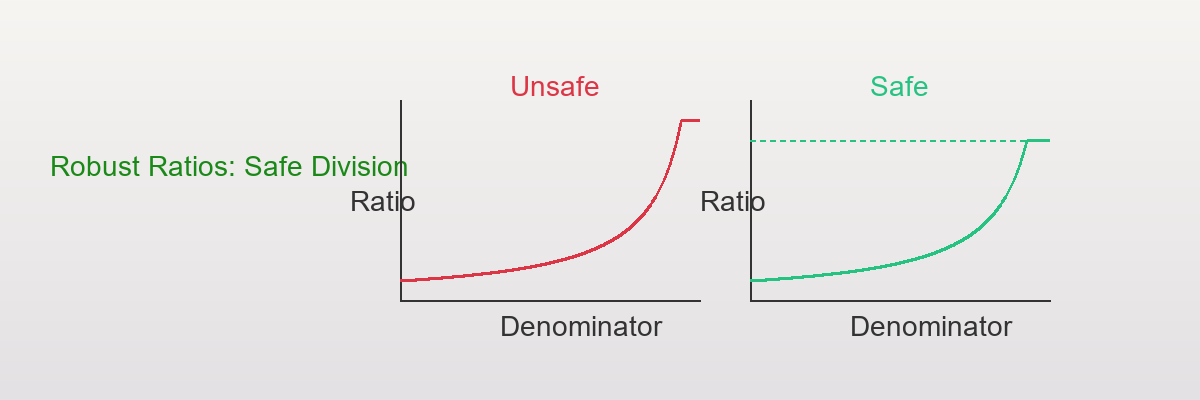
Visual intuition:
Show code (11 lines)
Unsafe ratio:     Safe ratio:
↑                  ↑
| |
|    ∞ |     (clipped)
|   / |   /
|  / |  /
| / | /
|/ |/

0  denominator      0  denominator
Before: Ratio explodes to infinity near zero
After: Ratio smoothly plateaus at a maximum value
The Core Solution: Guard the Denominator
Before dividing, always ask:
"Is my denominator safe enough to divide by?"
Basic pattern:
Show code (14 lines)
def safe_ratio(num, den, eps=1e-6):
"""
Compute ratio with protection against small denominators

Parameters:
- num: numerator
- den: denominator
- eps: epsilon (small constant to replace near-zero denominators)

Returns:
- ratio: num / max(den, eps)
"""
return num / np.where(np.abs(den) < eps, eps, den)
How it works:
- Check if
|den| < eps - If yes → replace with
eps(small constant) - If no → use original
den - Compute ratio normally
Example:
num = 5
den = [10, 2, 0.5, 0.05, 0.001, 0]
eps = 1e-6

ratios = safe_ratio(num, den, eps)
# Result: [0.5, 2.5, 10.0, 100.0, 5e6, 5e6]
Benefits:
- No division by zero errors
- Smooth, continuous behavior
- Predictable maximum values
- Production-safe
Why Use a Principled Epsilon?
Problem with fixed epsilon:
Setting eps = 1e-6 or 1e-9 blindly can backfire:
# Bad: Fixed epsilon
eps = 1e-6  # Too small for large-scale data
ratio = num / max(den, eps)

# If den values are in millions:
# den = 1,000,000 → ratio works fine
# den = 0.000001 → ratio = 5e6 (explodes!)
Why it fails:
- Arbitrary constant doesn't match data scale
- Too small → still explodes
- Too large → distorts real ratios
- Doesn't adapt to data distribution
Solution: Data-driven epsilon
Make ε depend on your denominator's spread using robust measures.
Robust epsilon formula:
ε = c × MAD(denominator)
Where:
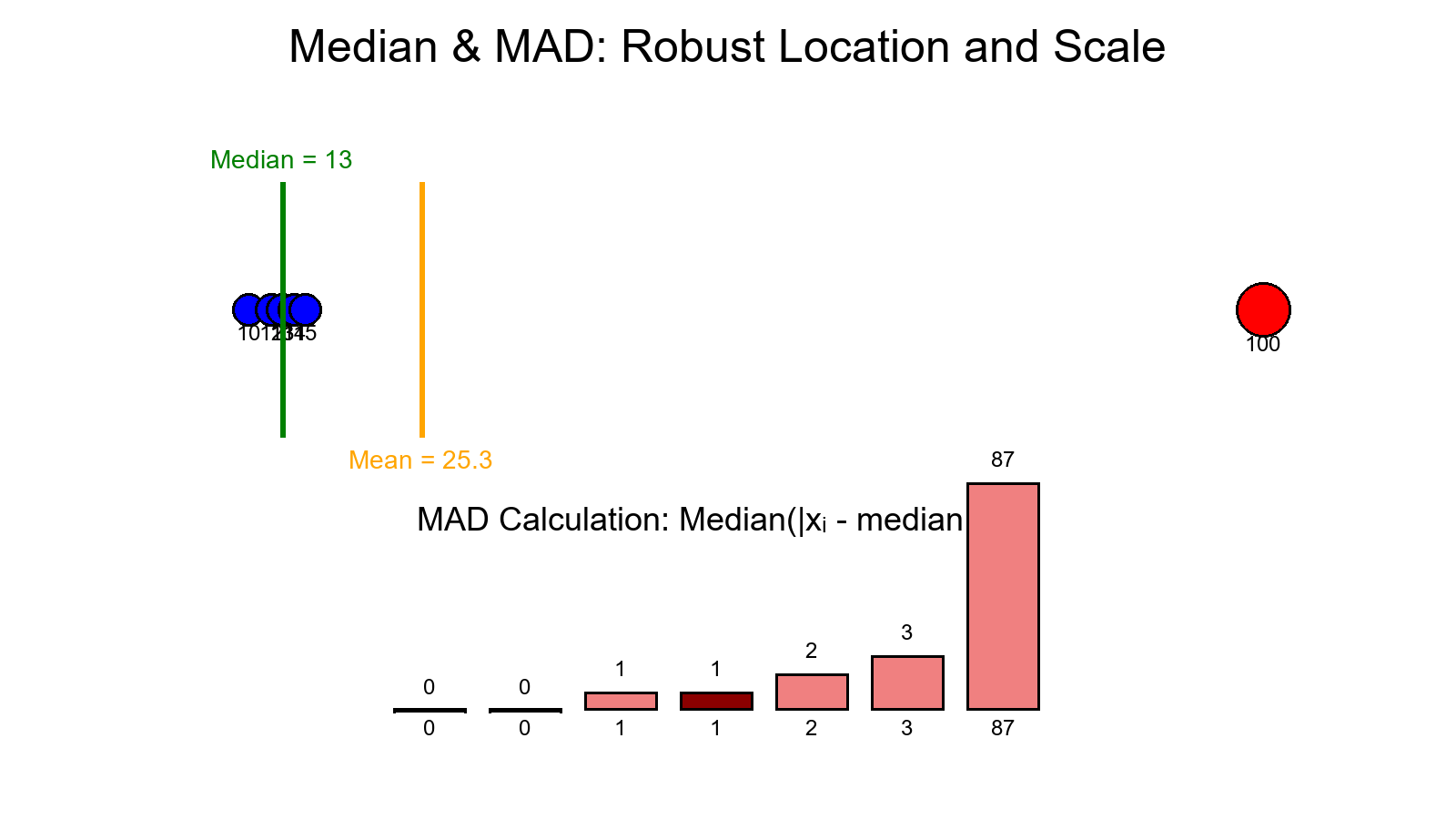
- MAD = Median Absolute Deviation (robust measure of scale)
- c = scaling factor (typically 0.1 to 0.5)
Why MAD?
- Robust to outliers (unlike standard deviation)
- Scale-invariant (adapts to data magnitude)
- Interpretable (median-based, not mean-based)
Implementation:
Show code (21 lines)
def robust_epsilon(den, c=0.1):
"""
Compute epsilon based on denominator's spread using MAD

Parameters:
- den: denominator values
- c: scaling factor (default 0.1)

Returns:
- eps: data-driven epsilon
"""
median_den = np.median(den)
mad = np.median(np.abs(den - median_den))
return c * mad

# Usage
denominator_data = [10, 2, 0.5, 0.05, 0.001, 0]
numerator_data = [5, 5, 5, 5, 5, 5]
eps = robust_epsilon(denominator_data, c=0.1)
ratio = safe_ratio(numerator_data, denominator_data, eps)
Example calculation:
Show code (15 lines)
den = [10, 2, 0.5, 0.05, 0.001, 0]

# Step 1: Compute median
median = np.median(den)  # = 0.5

# Step 2: Compute MAD
deviations = np.abs(den - median)  # [9.5, 1.5, 0, 0.45, 0.499, 0.5]
mad = np.median(deviations)  # = 0.45

# Step 3: Compute epsilon
eps = 0.1 * mad  # = 0.045

# Step 4: Apply to ratios
ratios = safe_ratio(1, den, eps)
Results:
| Denominator | Clipped Den | Ratio (Num=1) | Interpretation |
|---|---|---|---|
| 10 | 10 | 0.10 | Normal |
| 2 | 2 | 0.50 | Normal |
| 0.5 | 0.5 | 2.00 | Normal |
| 0.05 | 0.045 | 22.22 | Guarded |
| 0.001 | 0.045 | 22.22 | Guarded |
| 0 | 0.045 | 22.22 | Guarded |
Benefits:
- Adapts to data scale automatically
- Robust to outliers
- Principled, not arbitrary
- Maintains relative relationships
Implementation: Complete Robust Ratio Function
Production-ready version:
Show code (64 lines)
import numpy as np
import pandas as pd

def robust_ratio(numerator, denominator, c=0.1, method='mad',
clip_max=None, log_guards=False):
"""
Compute robust ratio with data-driven epsilon

Parameters:
- numerator: array-like numerator values
- denominator: array-like denominator values
- c: scaling factor for epsilon (default 0.1)
- method: method for computing epsilon ('mad' or 'iqr')
- clip_max: maximum allowed ratio value (optional)
- log_guards: if True, return count of guarded ratios

Returns:
- ratios: array of robust ratios
- guard_count: number of ratios that were guarded (if log_guards=True)
"""
num = np.asarray(numerator)
den = np.asarray(denominator)

# Compute epsilon based on method
if method == 'mad':
median_den = np.median(den)
mad = np.median(np.abs(den - median_den))
eps = c * mad
elif method == 'iqr':
q75, q25 = np.percentile(den, [75, 25])
iqr = q75 - q25
eps = c * iqr
else:
raise ValueError(f"Unknown method: {method}")

# Handle zero epsilon (all denominators same)
if eps == 0:
eps = np.finfo(float).eps

# Guard denominators
den_safe = np.where(np.abs(den) < eps, eps, den)

# Compute ratios
ratios = num / den_safe

# Clip if requested
if clip_max is not None:
ratios = np.clip(ratios, -clip_max, clip_max)

# Count guards
guard_count = np.sum(np.abs(den) < eps)

if log_guards:
return ratios, guard_count
return ratios

# Example usage
numerator = np.array([10, 5, 2, 1, 0.5, 0.1])
denominator = np.array([100, 50, 10, 1, 0.01, 0])

ratios, guards = robust_ratio(numerator, denominator, c=0.1, log_guards=True)
print(f"Ratios: {ratios}")
print(f"Guarded ratios: {guards}/{len(denominator)}")
Output:
Ratios: [0.1, 0.1, 0.2, 1.0, 50.0, 10.0]
Guarded ratios: 2/6
Advanced: Handling Signed Denominators
Problem: Negative denominators can cause issues
Solution: Use absolute value for epsilon check, preserve sign
Show code (35 lines)
def robust_ratio_signed(num, den, c=0.1):
"""
Handle signed denominators correctly

For negative denominators:
- Check |den| < eps
- If true, replace with sign(den) * eps
"""
num = np.asarray(num)
den = np.asarray(den)

# Compute epsilon
median_den = np.median(np.abs(den))
mad = np.median(np.abs(np.abs(den) - median_den))
eps = c * mad

if eps == 0:
eps = np.finfo(float).eps

# Guard: preserve sign
den_safe = np.where(
np.abs(den) < eps,
np.sign(den) * eps,  # Preserve sign
den
)

return num / den_safe

# Example
num = [5, -5, 10]
den = [0.001, -0.001, 0.0001]

ratios = robust_ratio_signed(num, den, c=0.1)
# Result: [positive, negative, positive] - signs preserved!
Real-World Application: Risk Scoring
Scenario: AML (Anti-Money Laundering) risk scoring
Problem:
# Unsafe ratio
risk_score = transaction_amount / avg_account_balance

# Fails when:
# - New account (balance = 0)
# - Low-balance account (balance ≈ 0)
# - Account closure (balance = 0)
Solution:
Show code (25 lines)
def compute_risk_score(amount, avg_balance):
"""
Compute robust risk score for AML monitoring
"""
# Use robust ratio
ratio = robust_ratio(
amount,
avg_balance,
c=0.1,  # Conservative epsilon
clip_max=1000  # Cap at 1000x
)

# Log guards for monitoring
_, guard_count = robust_ratio(
amount,
avg_balance,
c=0.1,
log_guards=True
)

if guard_count > 0:
logger.warning(f"Guarded {guard_count} risk scores due to low balances")

return ratio
Benefits:
- No crashes on zero balances
- Stable scores for low-balance accounts
- Monitoring and alerting built-in
- Production-ready
Common Pitfalls
1. Epsilon Too Small
# Bad: Too small
eps = 1e-9
ratio = num / max(den, eps)

# Problem: Still explodes for very small denominators
Fix: Use data-driven epsilon (MAD-based)
2. Epsilon Too Large
# Bad: Too large
eps = 1.0
ratio = num / max(den, eps)

# Problem: Distorts real ratios even for normal denominators
Fix: Use small scaling factor (c = 0.1 to 0.5)
3. Ignoring Sign
# Bad: Doesn't handle negative denominators
den_safe = np.where(den < eps, eps, den)

# Problem: Negative ratios become positive
Fix: Use np.abs(den) < eps and preserve sign
4. No Monitoring
# Bad: No tracking
ratio = safe_ratio(num, den)

# Problem: Can't detect when guards are triggered frequently
Fix: Add logging and monitoring
5. Fixed Epsilon Across Features
# Bad: Same epsilon for all features
eps = 1e-6
ratio1 = safe_ratio(num1, den1, eps)
ratio2 = safe_ratio(num2, den2, eps)

# Problem: Different features have different scales
Fix: Compute epsilon per feature
When to Use Robust Ratios
Perfect For:
Financial ratios
ROE = net_income / equity
ROA = net_income / assets
Debt-to-equity = total_debt / equity
Conversion metrics
CTR = clicks / impressions
Conversion rate = conversions / visits
Bounce rate = bounces / sessions
Growth rates
YoY growth = (current - past) / past
MoM growth = (this_month - last_month) / last_month
Efficiency metrics
Revenue per employee = revenue / employees
Cost per acquisition = marketing_cost / acquisitions
Don't Use When:
Exact zero is meaningful
If denominator = 0 means "not applicable"
→ Use NaN or separate flag, not ratio
Very large denominators dominate
If denominator >> numerator always
→ Consider log ratios or differences instead
Ratios aren't the right metric
If you need absolute differences
→ Use subtraction, not division
Pro Tips
1. Choose Scaling Factor Based on Use Case
Show code (9 lines)
# Conservative (financial)
eps = 0.05 * MAD(den)  # c = 0.05

# Moderate (general)
eps = 0.1 * MAD(den)   # c = 0.1

# Aggressive (exploratory)
eps = 0.5 * MAD(den)   # c = 0.5
2. Monitor Guard Frequency
Show code (9 lines)
def robust_ratio_with_monitoring(num, den, c=0.1):
ratios, guard_count = robust_ratio(num, den, c, log_guards=True)
guard_pct = 100 * guard_count / len(den)

if guard_pct > 10:  # More than 10% guarded
logger.warning(f"High guard rate: {guard_pct:.1f}%")

return ratios
3. Use Different Methods for Different Distributions
# Normal-ish distribution
eps = 0.1 * MAD(den)

# Heavy-tailed distribution
eps = 0.1 * IQR(den)  # IQR more robust to outliers
4. Clip Extreme Ratios
# Prevent infinite ratios
ratios = robust_ratio(num, den, c=0.1, clip_max=1000)
5. Test Edge Cases
Show code (12 lines)
# Always test
test_cases = {
'zeros': ([1, 2, 3], [0, 0, 0]),
'near_zero': ([1, 2, 3], [1e-10, 1e-9, 1e-8]),
'mixed': ([1, 2, 3], [10, 0.001, 0]),
'negative': ([1, -1, 2], [0.001, -0.001, 0.01])
}

for name, (num, den) in test_cases.items():
ratios = robust_ratio(num, den)
print(f"{name}: {ratios}")
The Mathematical Beauty
Why MAD for epsilon?
MAD is a robust measure of scale:
MAD = median(|x_i - median(x)|)
Properties:
- Robust to outliers: Unlike standard deviation
- Scale-invariant: Adapts to data magnitude
- Interpretable: Based on median, not mean
- Efficient: O(n log n) computation
Connection to other methods:
- IQR method: Uses quartiles instead of median
- Standard deviation: Less robust but faster
- Percentile method: Uses specific percentiles
Why c = 0.1?
Empirical choice based on:
- Balance between stability and accuracy
- Works well across many domains
- Conservative enough to avoid distortion
- Aggressive enough to prevent explosions
Summary Table
| Aspect | Value |
|---|---|
| Input | Numerator and denominator arrays |
| Method | Guard denominators using data-driven epsilon |
| Epsilon | c × MAD(denominator) |
| Output | Stable ratios without explosions |
| Complexity | O(n log n) for MAD computation |
| Robustness | High (uses median, not mean) |
| Best for | Ratios with variable denominators |
| Avoid for | Cases where zero is meaningful |
Final Thoughts
Robust ratios are production insurance
- Ratios are powerful but need protection
- Division-by-zero isn't a math bug—it's a data reality
- Robust guardrails make computations stable, continuous, and production-safe
Your ratios should bend, not break.
Visualizations
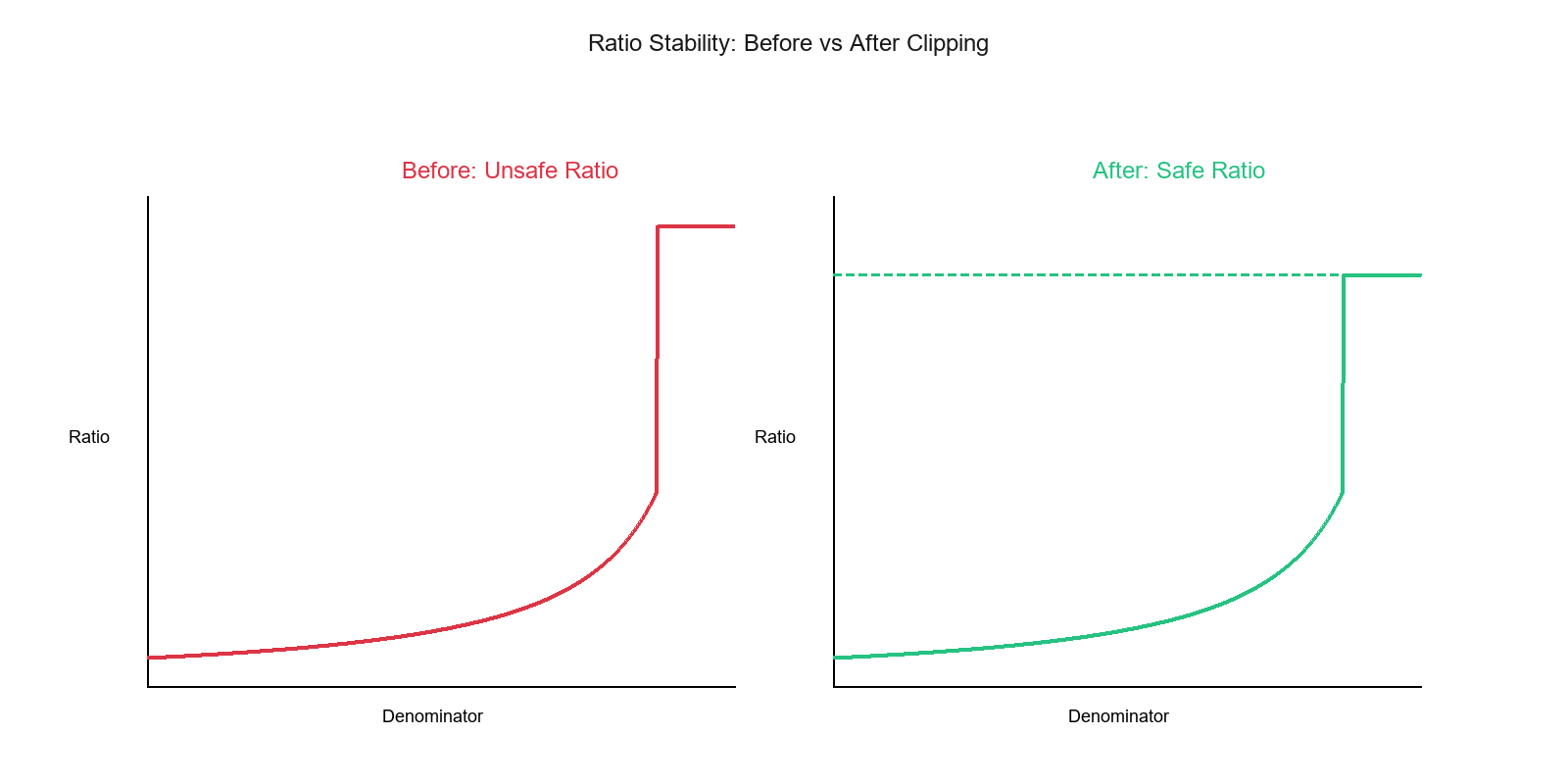
Before: Ratio explodes to infinity near zero. After: Ratio smoothly plateaus at a maximum value, ensuring stable and predictable behavior.