
Day 25: Configuration Pairing Logic and Equivalence Classes
The Problem: Complementary Segments Need Alignment
Scenario: Your classification system has complementary segment pairs:
- Premium / Standard (membership tier)
- Verified / Unverified (validation status)
- Enterprise / Consumer (customer type)
Challenge: Each pair must have:
- Consistent structure — Same parameters defined
- Logical completeness — Every entity falls into one category
- Aligned configurations — Compatible handling logic
Question: How do we formally define and validate these pairings?
Equivalence Relations: The Foundation
What is an Equivalence Relation?
An equivalence relation ∼ on a set S satisfies three properties:
- Reflexive: a ∼ a (every element relates to itself)
- Symmetric: If a ∼ b, then b ∼ a
- Transitive: If a ∼ b and b ∼ c, then a ∼ c
Equivalence Classes
An equivalence class [a] contains all elements equivalent to a:
[a] = { x ∈ S : x ∼ a }
Key Property: Equivalence classes partition the set:
- Every element belongs to exactly one class
- Classes are disjoint (no overlap)
- Union of all classes = entire set
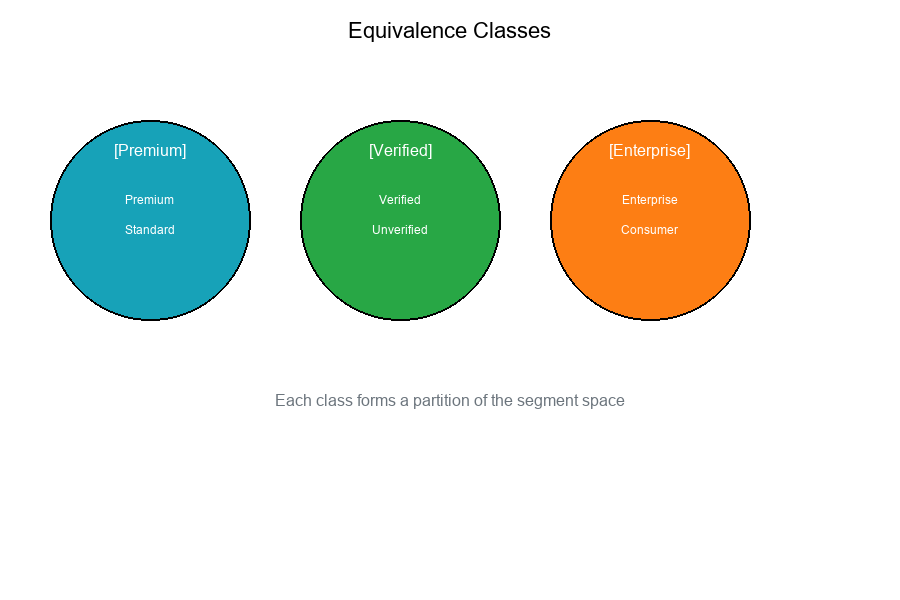
Example: Segment Pairing
Set S: All possible segment configurations
Relation ∼: "is a complement of"
Equivalence Classes:
[Premium] = { Premium, Standard }
[Verified] = { Verified, Unverified }
[Enterprise] = { Enterprise, Consumer }
Visual Example:
Pairing Consistency
What is Pairing Consistency?
Pairing consistency ensures that paired segments have compatible configurations.
Requirements:
- Same parameter set — Both segments define the same parameters
- Complementary coverage — Together they cover all cases
- No contradictions — Rules don't conflict
Formal Definition
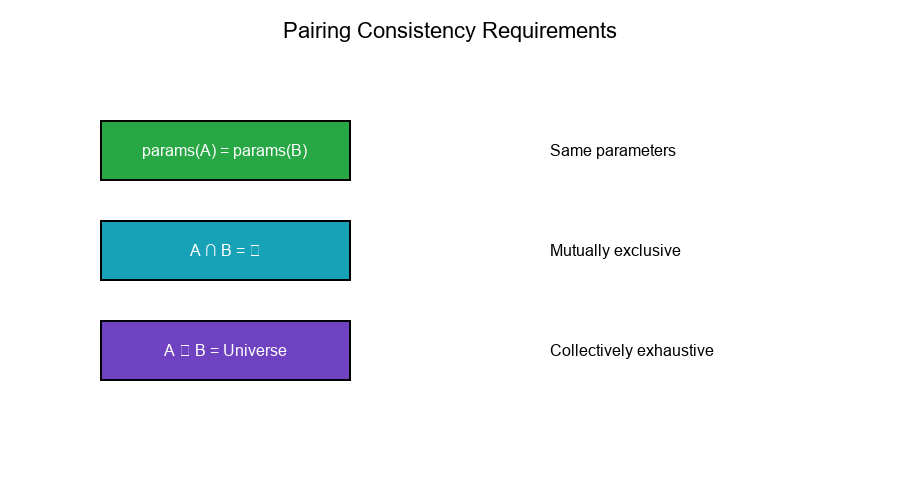
Let P = (A, B) be a pair of complementary segments.
Consistency Conditions:
1. params(A) = params(B)  (same parameter names)
2. A ∩ B = ∅               (mutually exclusive)
3. A ∪ B = Universe        (collectively exhaustive)
Example: Premium vs Standard
Premium Configuration:
premium_config = {
'min_membership_days': 180,  # days
'score_low': 0.3,
'score_high': 0.7,
'priority_levels': ['Low', 'Medium', 'High']
}
Standard Configuration:
standard_config = {
'min_membership_days': 0,    # days (different value, same param)
'score_low': 0.2,            # lower score (more conservative)
'score_high': 0.6,
'priority_levels': ['Low', 'Medium', 'High']  # same levels
}
Consistency Check:
- Same parameters defined
- Mutually exclusive (days < 180 vs days ≥ 180)
- Covers all members
Visual Example:
Mapping Functions: Aligning Parameters
The Role of Mapping Functions
Mapping functions translate parameters between paired segments to ensure alignment.
Purpose:
- Handle naming differences
- Apply transformations
- Fill in missing values
translate_bindings Function
Show code (25 lines)
def translate_bindings(source_config, target_segment, mapping_rules):
"""
Translate configuration from source to target segment.

Parameters:
- source_config: Configuration dictionary
- target_segment: Target segment name
- mapping_rules: Dictionary of parameter mappings

Returns:
- Translated configuration for target segment
"""
translated = {}

for param, value in source_config.items():
if param in mapping_rules:
rule = mapping_rules[param]
new_param = rule.get('rename', param)
transform = rule.get('transform', lambda x: x)
translated[new_param] = transform(value)
else:
translated[param] = value

return translated
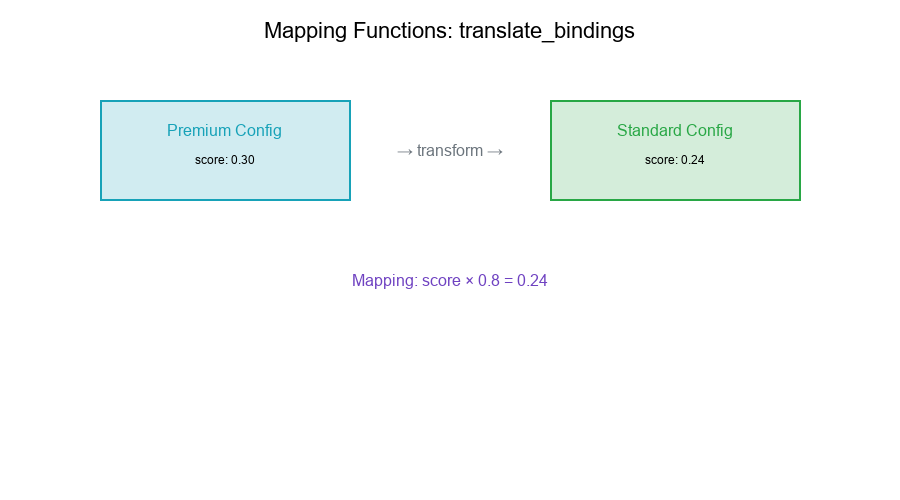
Example: Parameter Mapping
Mapping Rules:
Show code (11 lines)
mapping_rules = {
'score_low': {
'rename': 'score_low',
'transform': lambda x: x * 0.8  # Standard gets 80% of score
},
'score_high': {
'rename': 'score_high',
'transform': lambda x: x * 0.9  # Standard gets 90% of score
}
}
Application:
premium = {'score_low': 0.30, 'score_high': 0.70}
standard = translate_bindings(premium, 'Standard', mapping_rules)
# Result: {'score_low': 0.24, 'score_high': 0.63}
Visual Example:
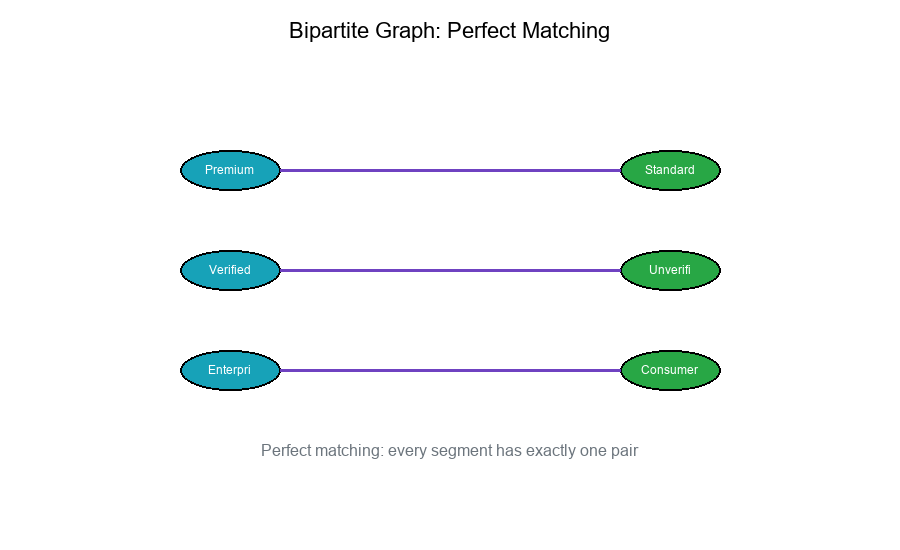
Bipartite Graph Matching
Visualizing Pairings as Graphs
Bipartite graph: A graph where vertices can be divided into two disjoint sets, with edges only between sets.
For segment pairing:
- Set A: Primary segments (Premium, Verified, Enterprise)
- Set B: Complement segments (Standard, Unverified, Consumer)
- Edges: Pairing relationships
Perfect Matching
A perfect matching in a bipartite graph:
- Every vertex in A is matched to exactly one vertex in B
- Every vertex in B is matched to exactly one vertex in A
- No unmatched vertices
For segment pairing: A perfect matching ensures every segment has exactly one complement.
Example: Segment Matching
Primary Segments      Complement Segments

Premium     ←→  Standard
Verified    ←→  Unverified
Enterprise  ←→  Consumer
Visual Example:
validate_and_pair_segments Function
Purpose
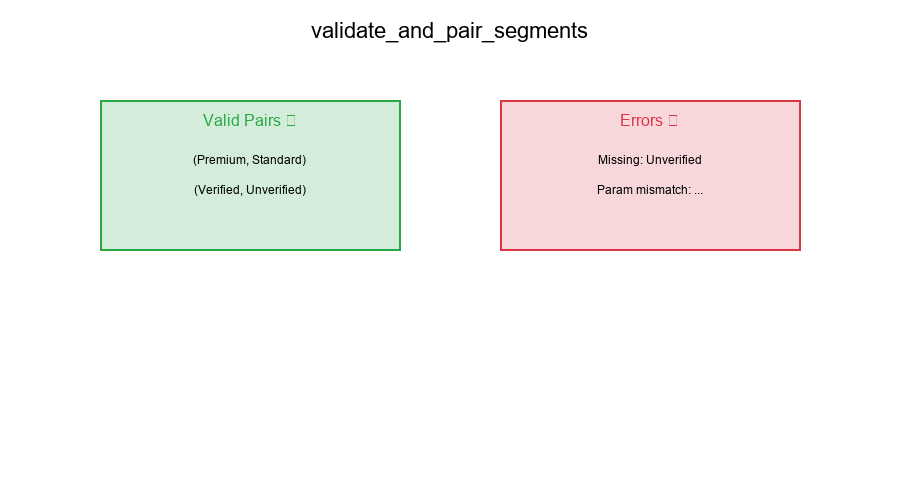
The validate_and_pair_segments function:
- Validates that all required pairs exist
- Checks consistency between paired segments
- Identifies missing or orphan segments
- Returns validated pairings
Implementation Concept
Show code (41 lines)
def validate_and_pair_segments(segment_configs, pairing_rules):
"""
Validate and pair segment configurations.

Parameters:
- segment_configs: Dict of segment -> config
- pairing_rules: List of (primary, complement) tuples

Returns:
- validated_pairs: List of validated (primary, complement) pairs
- errors: List of validation errors
"""
validated_pairs = []
errors = []

for primary, complement in pairing_rules:
# Check both segments exist
if primary not in segment_configs:
errors.append(f"Missing primary segment: {primary}")
continue
if complement not in segment_configs:
errors.append(f"Missing complement segment: {complement}")
continue

# Check parameter consistency
primary_params = set(segment_configs[primary].keys())
complement_params = set(segment_configs[complement].keys())

if primary_params != complement_params:
missing = primary_params - complement_params
extra = complement_params - primary_params
errors.append(f"Parameter mismatch: {primary}/{complement}")
errors.append(f"  Missing in complement: {missing}")
errors.append(f"  Extra in complement: {extra}")
continue

# All checks passed
validated_pairs.append((primary, complement))

return validated_pairs, errors
Example Usage
Show code (13 lines)
configs = {
'Premium': {'score': 0.5, 'levels': ['L', 'M', 'H']},
'Standard': {'score': 0.4, 'levels': ['L', 'M', 'H']},
'Verified': {'score': 0.6, 'levels': ['L', 'M', 'H']},
# Missing 'Unverified'!
}

rules = [('Premium', 'Standard'), ('Verified', 'Unverified')]

pairs, errors = validate_and_pair_segments(configs, rules)
# pairs: [('Premium', 'Standard')]
# errors: ['Missing complement segment: Unverified']
Visual Example:
Exercise: Floor Fill-In for Missing Priority Levels
The Problem
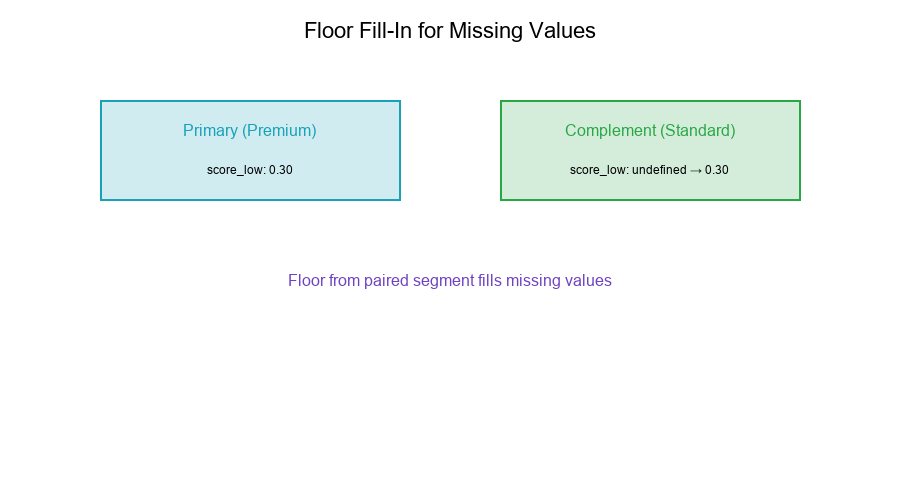
Theorem: Consistent pairing implies well-defined floor fill-in for missing priority levels.
Claim: If segments A and B are consistently paired, and A defines parameters for priority levels {L, M, H}, then missing parameters in B can be filled using A's values as a floor.
Prove this property.
Solution
Step 1: Define Consistent Pairing
Segments A and B are consistently paired if:
- params(A) = params(B) (same parameter names)
- levels(A) = levels(B) (same priority categories)
Step 2: Define Floor Fill-In
For any parameter p and priority level r:
B[p, r] = B[p, r] if defined
= A[p, r] if B[p, r] undefined (floor from A)
Step 3: Prove Well-Definedness
Assume consistent pairing. For any (p, r):
Case 1: B[p, r] is defined
- Use B[p, r] directly
Case 2: B[p, r] is undefined
- By consistent pairing, A defines the same parameters
- Therefore A[p, r] is defined
- Use A[p, r] as floor
Step 4: Uniqueness
The fill-in is unique because:
- If B[p, r] defined → use it (no choice)
- If B[p, r] undefined → use A[p, r] (no ambiguity)
Step 5: Conclusion
Consistent pairing guarantees:
- Every parameter in B has a well-defined value
- The floor comes from the paired segment A
- No ambiguity or undefined cases
∴ Floor fill-in is well-defined under consistent pairing. ∎
Practical Implication
Show code (12 lines)
def fill_missing_params(primary_config, complement_config):
"""
Fill missing parameters in complement using primary as floor.
"""
filled = complement_config.copy()

for param, value in primary_config.items():
if param not in filled or filled[param] is None:
filled[param] = value  # Floor fill-in

return filled
Visual Example:
Best Practices for Segment Pairing
1. Define Explicit Pairing Rules
Document which segments are paired:
PAIRING_RULES = [
('Premium', 'Standard'),
('Verified', 'Unverified'),
('Enterprise', 'Consumer'),
]
2. Validate Early and Often
Run validation on every configuration change:
pairs, errors = validate_and_pair_segments(configs, PAIRING_RULES)
if errors:
raise ConfigurationError(errors)
3. Use Mapping Functions for Transformations
Don't manually duplicate with modifications:
# Good: Use mapping
standard = translate_bindings(premium, 'Standard', rules)

# Bad: Manual duplication
standard = {'score': premium['score'] * 0.8, ...}
4. Document Fill-In Logic
Make floor fill-in explicit:
# Floor from Premium if Standard is missing
FLOOR_HIERARCHY = {
'Standard': 'Premium',
'Unverified': 'Verified',
}
5. Test Edge Cases
- Missing segments
- Extra (orphan) segments
- Parameter mismatches
- Null/undefined values
6. Version Control Pairings
Track changes to pairing rules alongside configuration changes.
Summary Table
| Concept | Definition | Use Case |
|---|---|---|
| Equivalence Relation | Reflexive, symmetric, transitive relation | Grouping complementary segments |
| Equivalence Class | All elements equivalent to each other | Segment pairs form classes |
| Pairing Consistency | Same params, mutually exclusive, exhaustive | Validating segment configurations |
| Mapping Function | Translates params between segments | Aligning paired configurations |
| Bipartite Matching | Perfect pairing between two sets | Ensuring every segment has a pair |
| Floor Fill-In | Use paired segment for missing values | Handling incomplete configs |
Final Thoughts
Segment pairing logic ensures that complementary categories work together consistently. By applying equivalence relations and mapping functions, we create a robust system where:
- Every segment has a well-defined complement
- Parameters align across pairs
- Missing values have principled fill-in
Key Takeaways:
Equivalence relations group complementary segments into classes Pairing consistency ensures compatible configurations Mapping functions translate parameters systematically Bipartite matching visualizes and validates pairings validate_and_pair_segments operationalizes validation Floor fill-in handles missing values from paired segments
Pair your segments, align your configurations!